

Packing lunches on a wet winter morning, you're already juggling enough without becoming a supplement detective. One child is pale, another barely sees sunlight on weekdays, and a label in the chemist says vitamin D3 plus K2 like it's the answer to everything. It isn't that simple, and that's exactly why this topic needs a straight answer.
In Australia, the question isn't whether D3 and K2 sound clever together. It's whether the product in your hand is appropriately dosed, clearly labelled, and suitable for your child. That's the standard I'd use, and it's much more useful than hype about "bone support".
Table of Contents
- Why Australian Parents Are Asking About D3 and K2
- What D3 and K2 Actually Do in the Body
- The Australian Vitamin D Picture for Kids
- Age-Appropriate Dosing for Children
- How to Read a D3 Plus K2 Label
- Standalone D3 Plus K2 Versus a Daily Kids Multivitamin
- Safety, Interactions and When to See a Professional
- A Practical Decision Framework for Families
Why Australian Parents Are Asking About D3 and K2
A lot of parents end up looking at vitamin D3 plus K2 after a familiar chain of events. A child's GP mentions vitamin D, a winter illness run starts, someone in the family Googles bone health, and a combined gummy or capsule looks tidy and reassuring. The marketing is neat, the decision is not.
Australia has enough vitamin D insufficiency to keep this topic relevant, but not enough evidence to make every combined product a must-have. In the Australian Health Survey, about 23% of adults, roughly 4 million people, had vitamin D deficiency (Cambridge Journal of Nutrition). That tells you vitamin D matters here. It does not prove every child needs a D3-K2 combo.
What parents actually need to know
Families do not need a wellness slogan. They need to know whether a product is safe, correctly dosed, and relevant to their child's situation. Check sun exposure, diet, age, medications, and whether the bottle is a maintenance supplement or a treatment in disguise.
Practical rule: if a label leans harder on “support” language than on exact doses and age directions, treat it with suspicion.
That is the lens I would use. Focus on whether the product makes sense for a child in an Australian home, on a real shelf, with a real label and a real body.
What D3 and K2 Actually Do in the Body
A child's body does not care about supplement marketing. It cares about whether calcium is absorbed, where it is used, and whether the label matches the child's needs.
Vitamin D3 helps increase calcium absorption from food into the bloodstream. Vitamin K2 helps direct that calcium toward the proteins involved in bone formation and away from the wrong places, which is why the two ingredients are often sold as a pair.
D3 opens the gate, K2 handles the routing
Vitamin D3 is cholecalciferol. In plain terms, it supports intestinal absorption of calcium and phosphate, both of which matter for growing bones and teeth. Vitamin K2 is a menaquinone form of vitamin K. K1 is the main dietary form from leafy greens. Vitamin K is needed for gamma-carboxylation of proteins involved in coagulation and bone metabolism, including osteocalcin and matrix Gla protein (NHMRC nutrient reference values).
The mechanism is tidy, and that is exactly why the combo sells. D3 helps move calcium into circulation, K2 supports activation of proteins linked with bone mineralisation and calcification control. That does not mean every child needs both ingredients in the same bottle.
For a closer look at how calcium and vitamin D work together, see our guide on calcium and vitamin D.
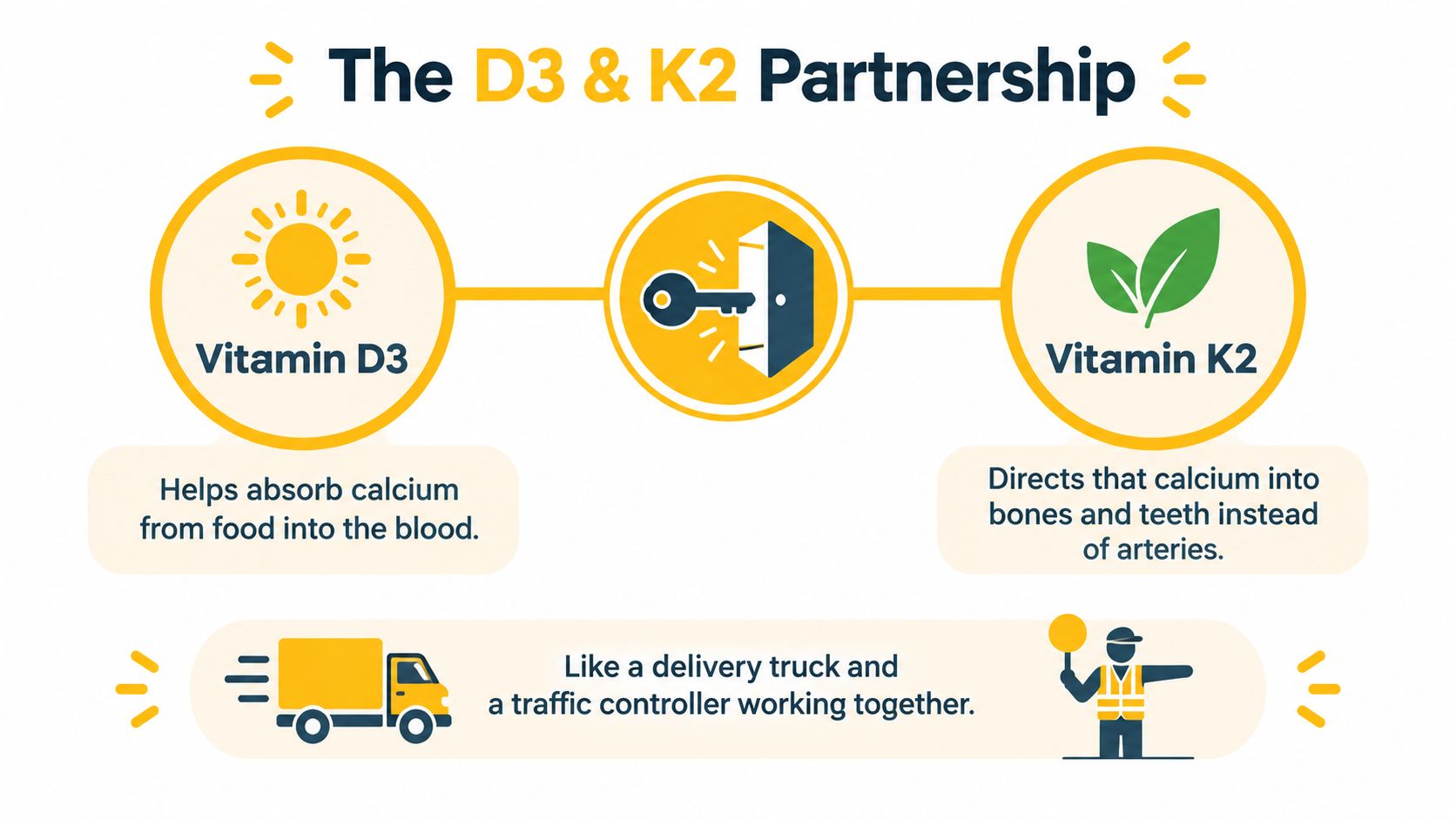
The body does not follow packaging logic. If a child has low vitamin D status, vitamin D needs to be addressed properly. That still does not automatically mean K2 should be added, and it definitely does not mean an adult-strength combination is suitable. For families comparing products, the key questions are dose, age suitability, and whether the label is clear enough to trust.
The Australian Vitamin D Picture for Kids
Australia has plenty of sunshine, yet vitamin D status still varies widely. National survey data on adults aged 25 years and older found that 20% had serum 25-hydroxyvitamin D below 50 nmol/L, 43% sat between 50 and below 75 nmol/L, and only 37% reached at least 75 nmol/L. Earlier AusDiab data showed 31% deficiency overall, with stronger seasonal swings in southern Australia.
A broader Australian analysis showed the same uneven pattern. Among Aboriginal and Torres Strait Islander adults, deficiency was about 27%, with 23% in non-remote areas and 39% in remote areas. Adolescents and young adults also showed notable deficiency rates, and the Australian Bureau of Statistics recorded major seasonal and state differences, including winter deficiency of 49% in Victoria and the ACT, 43% in Tasmania, compared with 15% in Queensland and 17% in the Northern Territory (Nature article on Australian vitamin D variation).
What that means for a child in Melbourne versus Cairns
A child in Melbourne with covered skin, indoor-heavy routines, and a winter school schedule sits in a very different position from a child in Cairns who gets regular outdoor time. Latitude, season, clothing, skin pigmentation, obesity, diet, and time outside all change the picture.
Good supplement advice starts with geography, not branding.
These are population patterns, not instructions for your child. Australian vitamin D data show why D3 can matter, but they do not prove that a combined D3-K2 product is the right default for every family. If your child has known deficiency, the decision belongs with a clinician, not a trendy shelf label.
For parents comparing options alongside food and routine support, a product like Focus includes vitamin D3 at 4 μg per daily serving, but that is a maintenance-style ingredient in a broader kids' gummy, not a treatment plan.
Age-Appropriate Dosing for Children
Parents get into trouble with vitamin D3 plus K2 when the label looks harmless but the dose is built for someone else. For children, the goal is usually maintenance, not treatment. The Royal Children's Hospital Melbourne lists routine maintenance supplementation at about 400 to 600 IU per day for children aged 1 to 18 years, while higher therapeutic doses are reserved for confirmed deficiency under medical supervision (Journal of Human Nutrition and Dietetics). If your child has a diagnosed deficiency, that is a clinician job.
Read the label in both units
A decent children's product should state vitamin D clearly in micrograms and IU. If the label only gives one unit, convert it before you buy. Do not assume a small-looking adult product is safe for a child, because total vitamin D exposure still matters when fortified foods or another multivitamin are already in the mix.
Vitamin K needs the same attention. Australian nutrient reference values set adequate intakes for total vitamin K at 35 micrograms per day for ages 4–8, 45 micrograms for ages 9–13, and 55 micrograms for ages 14–18. Those figures refer to total vitamin K, not a K2-specific target. If you are comparing gummy formats specifically, our guide to vitamin D3 gummies for kids covers the trade-offs parents should look at.
What I'd check before I buy
- Dose fit: Does the vitamin D amount suit your child's age and purpose, maintenance or treatment?
- Form clarity: Is it clearly listed as cholecalciferol for D3, and does the label name the K2 form?
- Stacking risk: Will this duplicate a multivitamin, fortified milk, or a prescribed vitamin D medicine?
- Age directions: Does the product state who it is for, or does it blur children and adults together?
If your child is already on a prescribed vitamin D medicine for deficiency, do not add a combined supplement casually. Read the back label first, and ignore packaging that sounds cosy while hiding the actual dose. That is where the bad products reveal themselves.
How to Read a D3 Plus K2 Label
The biggest label problem with vitamin D3 plus K2 is that it often sounds tidy while hiding poor fit. The Therapeutic Goods Administration reviewed a D3/K2 product in 2025 and found its bone-strength claim wasn't adequately substantiated, the evidence didn't match the product's population, ingredients, dosage, or outcomes, and the product was withdrawn from supply (TGA compliance report). It had also claimed use in children and infants without evidence covering that group.
The numbers that matter on the shelf
A separate TGA compliance investigation found a D3/K2 medicine with 41.68 micrograms of vitamin D and 167 micrograms of vitamin K per tablet, above Australia's permitted listed-medicine limits of 25 micrograms of vitamin D, 45 micrograms of vitamin K for children under 10, and 90 micrograms for ages 10 to 18 (TGA compliance report). That's not a minor formatting issue. That's a product problem.
The practical takeaway is simple. The front label can say “bone support” all day long, but the back label is where the truth lives. If you can't see the exact vitamin D amount, the K2 form, and the child age range, the product is not worth trusting.
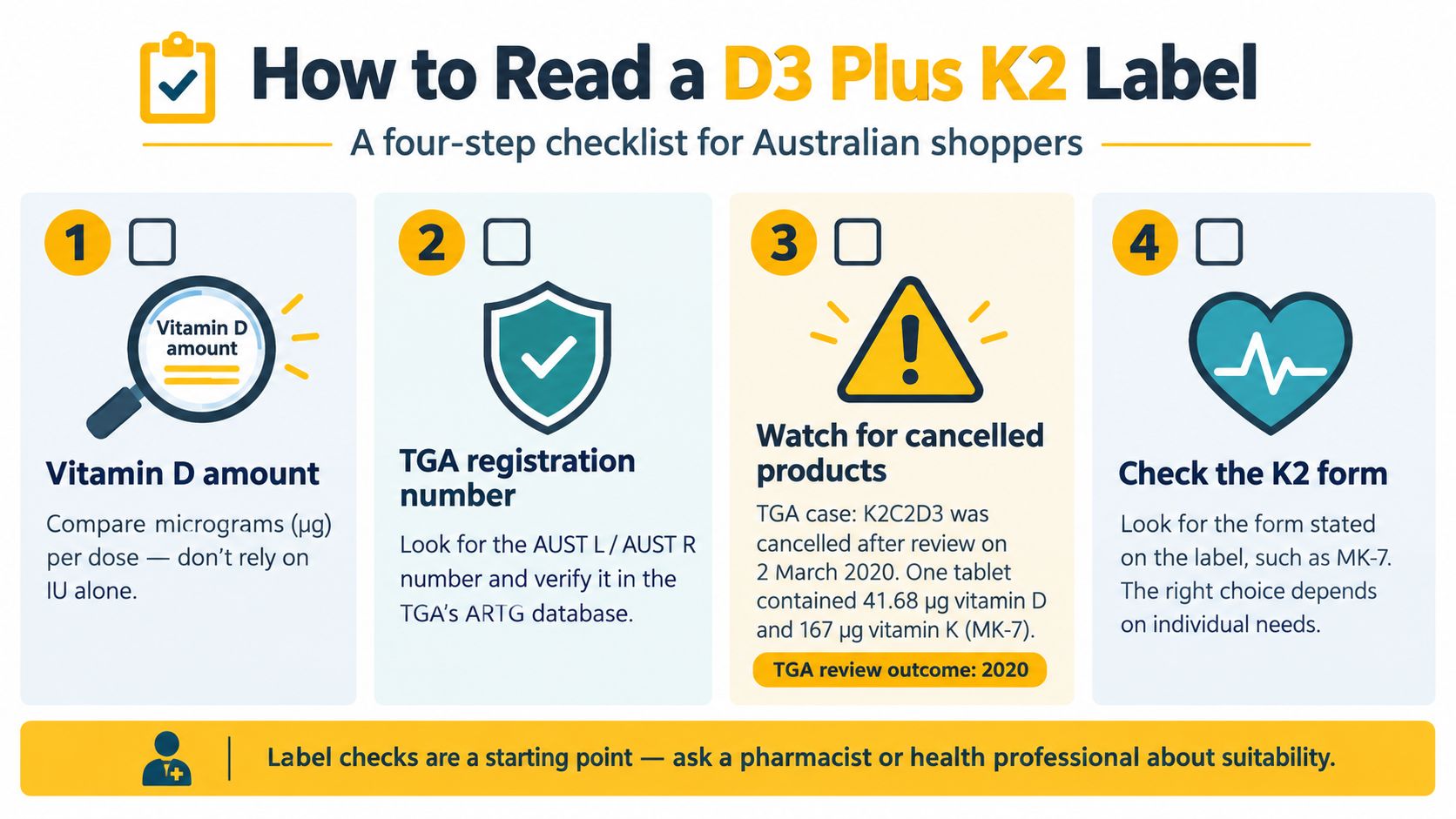
Shelf checklist
- Check the vitamin D amount: Look for the exact micrograms and the IU equivalent.
- Check the K2 form: The label should say what menaquinone form it uses, not just “K2”.
- Check the age fit: Adult-strength products are not automatically child-safe.
- Check the regulator cue: If the product has been cancelled or withdrawn, don't treat it as a bargain with a backstory.
If a label promises more than it can prove, walk away. A clean label is more important than a glossy claim.
Standalone D3 Plus K2 Versus a Daily Kids Multivitamin
A dedicated D3-K2 product is not always the right call. A child may already be getting vitamin D from a daily multivitamin, fortified food, or a maintenance gummy, so adding another supplement just duplicates the same nutrient. The question is simple: what is already in the routine, and what does the label say?
If you're unsure whether a daily multivitamin already covers vitamin D, read our breakdown of multivitamins with vitamin D. Count that first before adding anything else.
As noted earlier, a maintenance gummy may already supply 4 μg of vitamin D3 per daily serving, so an extra D3-K2 product can turn into pointless overlap. That is a label issue, not a wellness upgrade.
| When a dedicated D3 plus K2 product adds value | Child's situation | Best fit | Why |
|---|---|---|---|
| Very low dietary vitamin D and no other supplement | Limited intake, low sun exposure, no duplicate products | Targeted clinician-guided support | The child needs a plan, not guesswork |
| Already taking a multivitamin with D3 | Routine already covers vitamin D maintenance | Usually no extra D3-K2 | Duplication adds risk without obvious benefit |
| Needs a simple daily gummy routine | Family wants a maintenance product with clear dosing | Single maintenance product | Easier to keep consistent |
| Confirmed deficiency | Testing and medical history point to low status | Prescribed treatment, not self-selection | Therapeutic dosing belongs with the GP |
For most healthy kids with varied food intake and some outdoor time, a dedicated D3-K2 product is not the default answer. A plain children's multivitamin or a maintenance-level vitamin D product is often enough, and sometimes nothing is needed at all. If a parent wants one routine that already includes vitamin D support, choose that on purpose and do not stack products just because the labels look tidy.
Safety, Interactions and When to See a Professional
Vitamin K is not harmless just because it is a vitamin. It can interfere with vitamin-K-antagonist anticoagulants such as warfarin, so any family using a K2 product needs to tell a clinician first. NPS MedicineWise gives the same basic warning, and that matters even more when a child has a medical condition.
Call a clinician sooner if your child has any of these
- A prescribed vitamin D medicine already: Do not stack another D3 product without review.
- A bleeding disorder or anticoagulant use in the household: K2 needs extra caution.
- Liver disease or malabsorption: Vitamin handling may be different.
- Upcoming surgery: Supplements should be disclosed, not hidden in the bathroom cabinet.
- Unclear symptoms or repeated deficiency: Testing and guidance beat guessing.
The TGA is clear in practice. Vitamins can cause adverse effects or interact with medicines, and they should be taken according to label directions. Adult-strength products, “one a day miracle” branding, or vague age guidance are all red flags. I would also be wary of labels that push a child product while burying the actual dose.
Straight rule: if a supplement needs to sit beside a medicine, decide that with a clinician, not at the shelf.
Sugar-free and vegan formulas can help with family routines, but they do not make a product safe by themselves. They are product features, nothing more. The safety check is simple. Dose, age, medication profile, and reason for use all need to line up.
A Practical Decision Framework for Families
Start with the child, not the bottle. Check diet and sun exposure, then look at what else they already take, especially multivitamins or prescribed medicines. Read the label for vitamin D in micrograms and IU, confirm the K2 form and amount, and skip products that blur child and adult use.
If your child is healthy, eats a reasonable diet, and gets some outdoor time, a dedicated vitamin D3 plus K2 product usually is not necessary. If there is confirmed low vitamin D, bone concerns, a medical condition, or medication interactions, speak to a GP or pharmacist first. For families who want a maintenance-style routine, the kids' gummy mentioned earlier shows what a sensible maintenance-level vitamin D dose looks like on a label.
A good shelf test is simple. Clear age guidance, honest dosing, and no adult-strength packaging. Bad products shout benefits and hide the details.